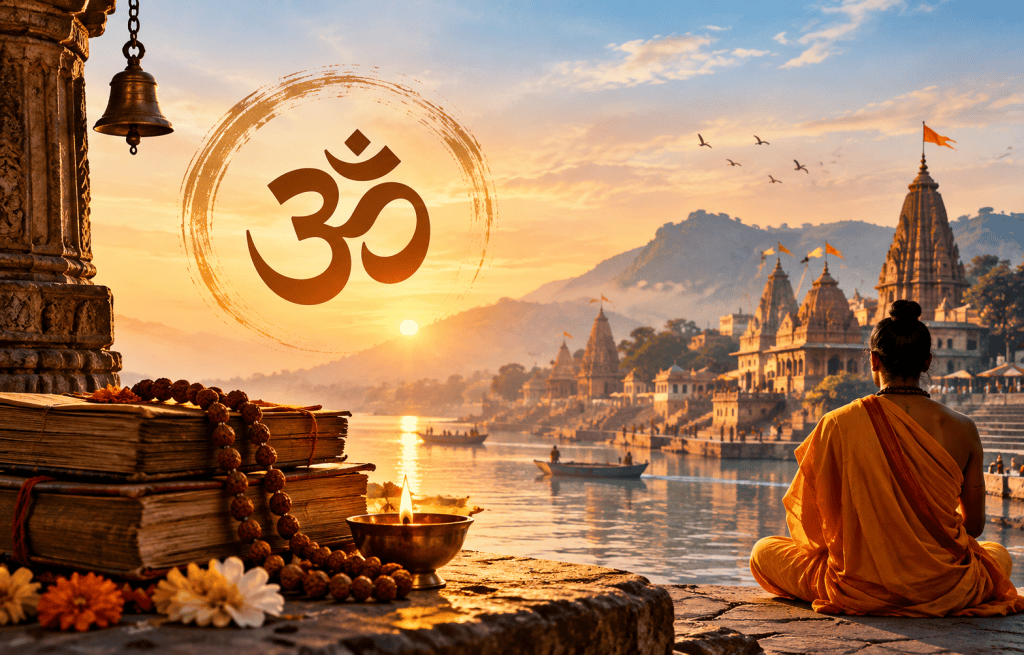
Sanatan Dharma, often referred to in the modern world as Hinduism, is one of the oldest living spiritual and philosophical traditions on Earth. The term itself comes from Sanskrit: Sanatan meaning eternal, timeless, or without beginning and end, and Dharma meaning duty, righteousness, natural law, or the order that upholds existence. Together, the phrase points to something larger than a single religion — an eternal way of living in harmony with truth, duty, and the underlying order of the universe.
Unlike traditions founded by a single figure at a specific point in history, Sanatan Dharma has no single founder and no fixed starting date. Its practitioners often describe it not as something that was created, but as something that was realized — truths perceived by sages and seers, known as rishis, through deep meditation and spiritual insight, and then passed down across generations.
The Meaning of Dharma
At the heart of this tradition is the concept of dharma itself — a word that resists easy translation into English. It encompasses one’s duty, one’s ethical responsibility, the natural order of things, and the path that sustains balance in the world. Dharma is not a rigid set of commandments handed down once and for all; it is understood as something that can express itself differently depending on a person’s stage of life, role in society, and personal circumstances, while still being anchored in universal principles such as truthfulness, non-violence, self-restraint, and compassion.
This flexibility is part of what has allowed Sanatan Dharma to absorb an extraordinary diversity of beliefs, practices, and philosophical schools over thousands of years without insisting on a single, uniform doctrine.
Sacred Texts and Wisdom Literature
The textual foundation of Sanatan Dharma is vast, layered, and built up over an immense span of time. Scholars broadly divide these texts into two categories: shruti, meaning “that which is heard,” and smriti, meaning “that which is remembered.”
The Vedas form the oldest layer of shruti literature, composed in Sanskrit and traditionally regarded as divinely revealed knowledge received by ancient sages. The four Vedas — Rig, Yajur, Sama, and Atharva — contain hymns, philosophical reflections, ritual instructions, and cosmological insights.
The Upanishads, appended to the end of the Vedas, shift the focus toward philosophical inquiry: the nature of the self (atman), the nature of ultimate reality (Brahman), and the relationship between the two. These texts form the foundation of much of later Hindu philosophy and continue to be studied for their meditative depth.
The Bhagavad Gita, part of the great epic the Mahabharata, is perhaps the most widely read and cherished text within the tradition. Framed as a dialogue between the warrior Arjuna and Lord Krishna on the eve of a great battle, it addresses duty, action without attachment to results, devotion, and the path toward inner freedom.
The Puranas are a body of sacred literature containing genealogies, cosmology, devotional narratives, and moral teachings centered on various forms of the divine. Alongside the great epics — the Ramayana and the Mahabharata — these sacred narratives have shaped the moral imagination, festivals, art, and storytelling traditions of the Indian subcontinent for millennia. They are treated by practitioners not as historical record in the modern sense, but as sacred teaching stories carrying deep spiritual and ethical meaning.
The Nature of the Divine
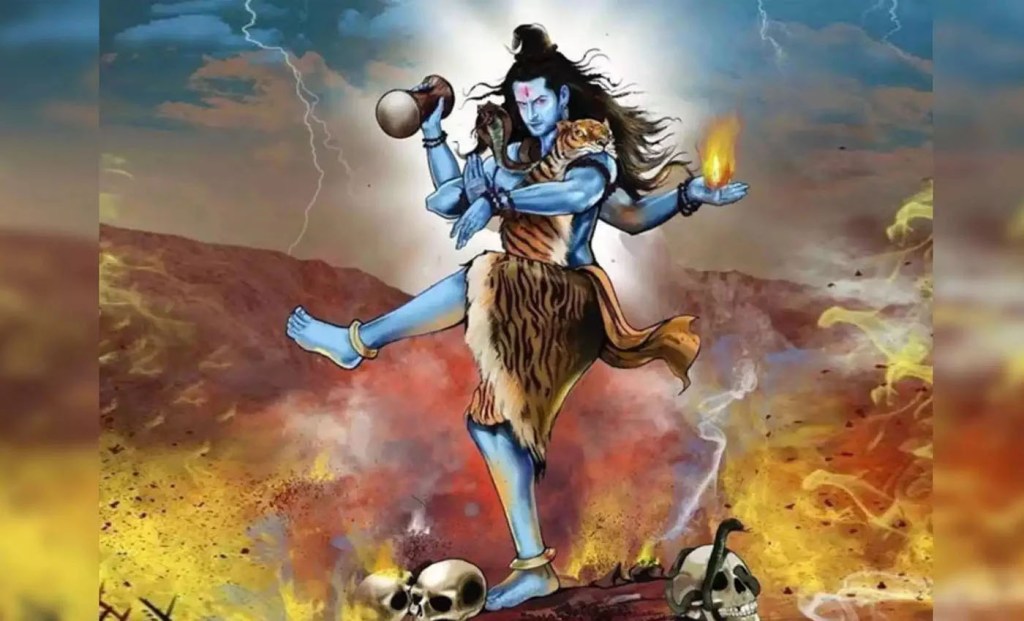
One of the most distinctive features of Sanatan Dharma is its expansive understanding of the divine. At the philosophical core, many schools within the tradition hold that there is a single, formless, ultimate reality — Brahman — that pervades and underlies all existence. The countless deities revered within the tradition, such as Vishnu, Shiva, Devi in her many forms, Ganesha, and others, are understood by most practitioners not as separate, competing gods, but as different faces, expressions, or aspects of that one underlying reality, each emphasizing a different quality: preservation, transformation, wisdom, compassion, strength, or creativity.
This is often summarized by a well-known Vedic phrase: Ekam Sat Vipra Bahudha Vadanti — “Truth is one; the wise call it by many names.” This principle has historically supported a broad spirit of inclusiveness, allowing devotion to a personal deity (Ishta Devata) to coexist comfortably with a philosophical understanding of ultimate oneness.
Core Philosophical Concepts
Several foundational ideas recur across the many schools of thought within Sanatan Dharma:
- Karma — the principle that every action carries consequences, shaping one’s present and future circumstances, both in this life and beyond.
- Samsara — the cycle of birth, death, and rebirth through which the soul passes as it works through the consequences of karma.
- Moksha — liberation from this cycle, understood as the ultimate goal of spiritual life, achieved through self-realization and union with, or recognition of, the ultimate reality.
- Atman — the eternal, unchanging self or soul, which many philosophical schools hold to be identical in essence with Brahman itself.
- Ahimsa — non-violence in thought, word, and deed, considered one of the highest ethical virtues.
Different philosophical schools, such as Advaita Vedanta (non-dualism), Vishishtadvaita (qualified non-dualism), and Dvaita (dualism), offer distinct interpretations of the relationship between the individual soul and ultimate reality, reflecting the tradition’s comfort with multiple valid paths toward the same truth.
Paths of Practice
Sanatan Dharma recognizes that people are drawn toward the divine and toward self-realization through different temperaments and inclinations. Classical teaching describes several complementary paths, often called yogas:
- Bhakti Yoga — the path of loving devotion to a personal form of the divine.
- Jnana Yoga — the path of knowledge and philosophical inquiry into the nature of the self and reality.
- Karma Yoga — the path of selfless action, performing one’s duties without attachment to personal reward.
- Raja Yoga — the path of meditation and disciplined inner practice, including the physical and breathing practices widely known today simply as yoga.
Daily life within the tradition is often woven with ritual and remembrance — prayer, meditation, offerings at a home shrine, visits to temples, and participation in festivals that mark the turning of the seasons and important spiritual events. Festivals such as Diwali, the festival of lights symbolizing the victory of light over darkness; Holi, celebrating the arrival of spring and the triumph of good; and Navaratri, honoring the divine feminine, bring communities together in shared celebration and reflection.
The Four Aims of Life
Traditional teaching outlines four legitimate goals, or purusharthas, that together make for a well-lived human life:
- Dharma — righteous conduct and duty
- Artha — the pursuit of prosperity and material well-being, pursued ethically
- Kama — the pursuit of legitimate desires and pleasures
- Moksha — ultimate spiritual liberation
This framework reflects a holistic view of human existence, one that does not see spiritual life and worldly life as opposed to each other, but as parts of an integrated whole, each given its proper place and season.
A Living, Evolving Tradition
Sanatan Dharma has never been static. Across thousands of years, it has engaged in continuous dialogue with new ideas, new social conditions, and new generations of thinkers, reformers, and teachers — from ancient philosophers and poet-saints to modern spiritual figures who have brought its teachings to a global audience. Its emphasis on direct spiritual experience over rigid dogma has allowed it to remain a living tradition rather than a fixed relic of the past.
Today, Sanatan Dharma is practiced by well over a billion people worldwide, primarily across India and the wider Indian diaspora, but increasingly by people from many different backgrounds who are drawn to its philosophical depth, its practices of meditation and yoga, and its vision of a universe governed by an underlying moral and spiritual order.
Conclusion
At its heart, Sanatan Dharma offers a vision of human life as part of something vast, ordered, and sacred — where duty and devotion, knowledge and action, discipline and celebration all have their place. It is less a fixed set of beliefs than an invitation: to seek truth sincerely, to live with integrity, and to recognize the same eternal reality expressing itself in countless forms, including, ultimately, within oneself.


Leave a comment